Friday, January 31, 2020

Title Research: Hostage Movie

What movie was the title sequence from? 
For this blog i chose The movie hostage. The movie is about an officer in the Los Angeles Police Department (Jeff Talley) who quits the force and relocates his family to the suburbs. He becomes the the sheriff in a sleepy town, and thinks he has escaped the the hustle in his old job. All is well until an elaborate local heist puts him back in the center of action. 

How Long was the title sequence ? 
- The title sequence was 2 minutes and 56 seconds long. 

What website did the title sequence come from?
- The sequence was from www.watchthetitles.com

How many titles are displayed during the opening sequences to the film?
- There were 31 titles displayed during the opening sequence. Also, the title of the film was shown after 7 other titles came up on the screen.

What images are prioritized in the opening sequences ?
- There were men who were “paused” as in standing still. They were armed with heavy artillery and their gear had symbols from different police forces and departments, such as SWAT. The rooftops of the large buildings were also shown at different angles which explains the setting of the beginning of the film. 

What connotation do do the images carry? 
- Negative because heavy police presence usually  means there is a threat. Heavy artillery is deadly force used to take out an immediate threat.

How is genre reinforced through symbolic and technical codes from the outset?

 - Many of the shots in the titles are in front of pictures of the tops of buildings. They are also not in color which creates suspense and curiosity in the view were because he wants to know what the setting is going to be like.

How does the film establish an enigma from the outset?
- The music that is playing in the background is calm but it gets louder then calm again in a way. The music also has a suspenseful beat to it. Toward the end of the titles and when the film is about to begin, the sound decreased. This created suspense and tension because all of the sound that was playing before was action-like but then it suddenly cease-and-desists. 

What strategies are used to ensure the film appeals to its target audience?
- The title of this movie will cause individuals with interest in this genre or type of movie with draw them in. Also the titles quickly exit as soon as they enter which makes the process of showing them faster and makes it easier for individuals to not lose interest in the movie before it even starts.

How has technology been used effectively? (Consider camera angles, transitions and editing techniques)

- Fade in and fade outs created suspense. Also the aerial view shots of the tops of the city view established location.

Thursday, January 30, 2020

Title Research: Watch the Titles Website


    The website, watchthetitles.com, is a website that provides examples of titles in film. This includes movies, TV shows, and even interviews. A typical film title sequence includes multiple different things. Titles aren't just the title of the movie. Titles also include cast such as the director, and also notable actors. I chose to use this website for a few reasons. The first of which is the simplicity, as the site is easy to navigate. 
     The website is divided into 3 major categories: Title Sequences, Designers, and Studios. There is a search bar to find if there are title sequences included for a specific film. If just browsing, the website also has titles divided into different categories. The categories are Feature Film, TV Shows, Event Titles, Student Projects, and Video Games. With each category, there is a selection of titles from films of that category. Each title clip also has paragraphs written going into detail on the film. There is a brief summary of the plot, and the year the film was produced. There also is a section labelled 'complete cast'.

Tile Research: Art of the Title Website


      I am looking into the “artofthetitle” site because it’s an interesting site that is focused on intriguing movie titles. This site brings awareness to things that we typically look over when watching a film. This is specifically in the beginning. Throughout this site, I've seen multiple films with interesting titles. The site is introduced to a viewer by having the top 10 best title sequences of 2019 as the front page as you can see from the picture. Underneath these films, there's paragraphs that provides background information about the films and the meanings behind the titles. This site even dwells into the color schemes of titles. It lets you know why the titles may have been placed in that specific location, the feeling the titles may or may not be trying to draw from the audience, and even the production team behind it.
        This site has taught me that the titles have an enormous amount of importance to the film. Throughout this site, I've also learned that the directors emotions behind the film shines through in ways we wouldn't think of. Most films are the directors way of bringing awareness to an issue that may be important to him/her. Also, we can also even go as far as learning who/where the money for making this film came from. The names in the beginning is likely to be the names of the companies that aided in the film. This site is definitely the place to go for a further look into the meanings of titles. It gives an intense amount of detail that I highly doubt any other site has to offer.

Sunday, January 26, 2020

Genre Research: Denial Movie


         A film example of the Legal Drama genre is a movie titled "Denial". It can be found to watch on Hulu, and for sale on other platforms. It dramatizes the Irving v Penguin Books Ltd. case, where David Irving, a holocaust denier, sues author Deborah Lipstadt for libel. Irving tries to prove that there were no gas chambers.
       Lipstadt visits the former Auschwitz concentration campsite to gather evidence that the holocaust did in fact happen. The case concluded with Lipstadt as the victor. I found the film interesting, as it shows the extremities of the beliefs of some people. I liked how the film portrayed the case overall.

Camera Angles:
   - Medium long shot: the teacher is talking to the class
   -    Medium close up: the teacher near the glass window speaking to the students in the classroom
  -     High Angle: The can of food being emptied

Camera Shots :
⁃ Two shot: Her and the dog entering the room, she has a box in her hand as well
⁃ Point of View shot: Walking up the stairs and when the can of food is emptied
⁃ Medium Close up: When they introduce her as an author

Camera Movements:
⁃ Zoom: They zoom in on the lady’s face when she is praying outside in the snow
⁃ Tracking: Her walking around with the boxes in her hand
⁃ Flash pan: The transition from when she is on TV so when she is performing live about                        what she is saying
⁃ Stationery: When they enter the bar

Costumes: Throughout the film, the costume doesn't change much. It features a lot of formal and semi-formal attire, such as what you would find in a courtroom.

Lighting: The film consists of scenes that are both indoors and outdoors. In the outdoor scenes, the lightning is natural lighting, and in the indoor scenes, there are ceiling lights, and possibly lighting rigs.

Acting: The acting in the film helps to portray the plotline. The actors are able to make the viewer feel that what they say is their actual beliefs.

Makeup: Some of the female characters appear to be wearing makeup. Also, the hairstyles on characters are more likely than not done by the makeup team.

Props: Props in the film are all related to the scenes depicted. This includes the judge's gavel, and also plates and cups in a scene where the characters are eating.

Setting: Settings include in a restaurant, the courtroom, the remnants of a Nazi gas chamber, and a classroom.

Genre Research: Roman J. Israel, Esq. Movie

This movie was about a man named Roman. When his boss dies unexpectedly, he has to takeover and defend a young man accused of murdering a store clerk. What I liked about this film was the fact that the movie starts off by giving background story on how Roman was being disbarred. It had the qualities of what you would see in a court case packet, which was different than most movies I've seen.

What I disliked about this movie is that I felt that it moved too quickly. I feel like they should have established exactly who Roman's boss actually was and what he looked like, before he died.

Camera Angles:
1) Eye level: The camera was fixiated directly at the judge.
2) High angle: Roman and the book in his house.
3) Low angle: Camera is pointing up at the man.

Camera Movements:
1) Pan: This was a movement from the notepads on office shelves to Roman in the office.
2) Tracking: The camera was moving with Roman as he walked inside the courtroom.
3) Zoom: At the beginning of the movie, the zooming in on the words.

Camera Shots:
1) Three shot: Two men and a woman were talking in the courthouse.
2) Over the shoulder shot: The camera is over the defendant's shoulder, while Roman is in front of him, talking.
3) Two shot: The Judge and officer who was talking.

Editing:
1) Fade in: From a black screen, to the office.
2) Shot/ Reverse Shot: This shot was from Roman, to officer in the courthouse, back to Roman.
3) Eye-line match: This shows Roman looking out the window, and it shows what is out the window.

Sound:
1) Voiceover: This took place at the beginning of the movie, with the voice of Roman.
2) Dialogue: This dialogue was between Roman and a woman talking about William (Roman's boss who had a heart attack).
3) Digetic: The car sounds as Roman was walking to the courthouse.

Costumes:
Since this movie mostly takes place in a courthouse, policewear, an orange jumpsuit, and professional clothing is worn by people in the movie.

Lighting:
In the beginning of the movie, Roman is seen in an office, which has a sufficient amount of lighting. The movie then goes outside, which is natural lighting. Lastly, the courtroom is well lit, as important deeds are being taken care of.

Actors:
Since this is a legal based movie, most of the characters are normal people, and others acting as a defendant, a judge, lawyers, and officers.

Makeup:
The defendant is seen having a bruised eye when he talks to Roman. Also, the lawyer on the prosecution has light makeup on.

Props:
Brief cases, handcuffs, and a mallet are mostly shown throughout the movie.

Settings:
- The courtroom
- The office
- Outside
- The outside of the courtroom.

Genre Research: Western and Legal Drama


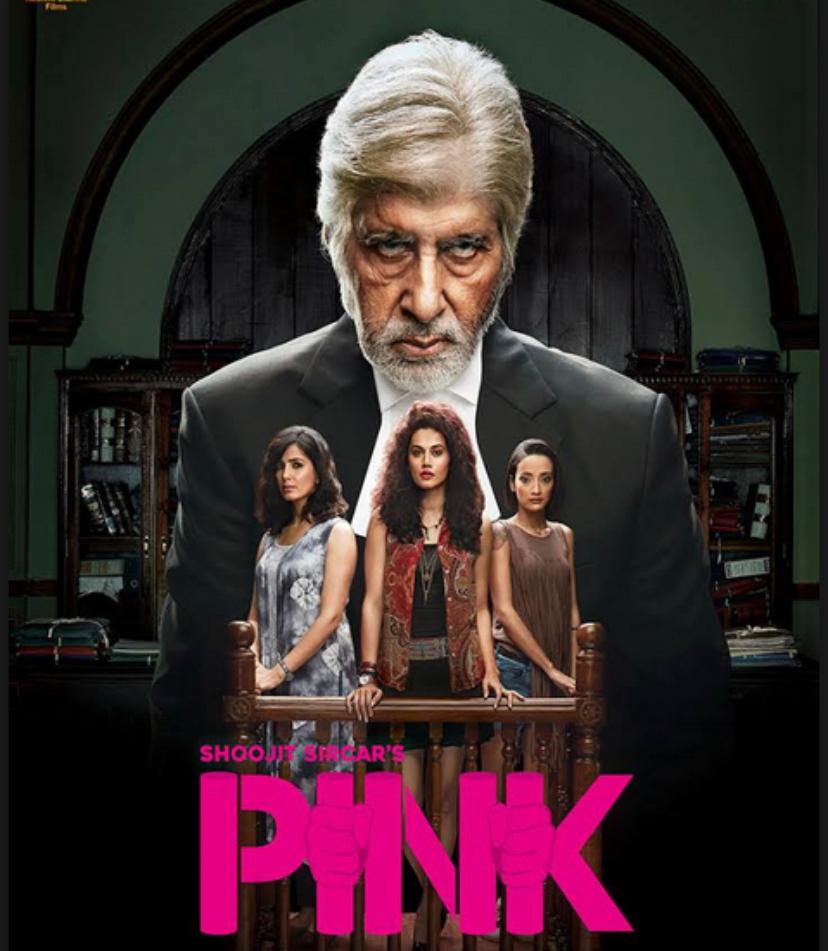
Genre Research: PINK Movie

       One of the movies that fall under the Legal Drama genre is a movie called “PINK”. This movie can be found on Netflix. It’s about a sexual assault victim that is getting charged unjustly with the attempted murder of the man that attacked her. She’s defended by a retired lawyer that challenges the rape laws in their country that is India. This movie was interesting as it brought awareness to the things that happens to people in other countries. I liked the fact that although the lawyer suffered from bipolar disorder that he was ashamed of, he still came out of retirement to defend these girls. Being that the attacker is the son of a politician, no other lawyer in town wanted to take the risk of defending her.
       What I didn’t like about this movie is the fact that it portrays Indian society towards women who don’t follow what they think is the right thing for women to do. Another reason why no one wanted to defend the victim is that they felt that she was in the wrong although she’s the one that got attacked. This movie was overall a whirlwind of emotions.

Camera Shots:
- Extreme Close Up:  First shot of the lawyer. He’s now introduced to the plot.
- Two Shot: The scene where the attacker and his friend were filmed on their way to the hospital.

Camera Angles: 
- Eye Level: This is filmed as the girls are panicking and in a frenzy about what happened.
- Low Angle: The

Camera Movement:
- Zoom: It zooms into the attackers' bruises
-Pan: This was used in the courtroom during the trial.

Costumes-
This movie takes place mostly at the police station, outside in the streets and the actor’s homes.

Lighting-
This film was shot indoors and outdoors. Outdoors there is natural lighting and indoors there is no ring light but there is the ceiling light.

Acting-
The acting in this movie is good. The girl plays her role as a damaged sexual assault victim being that later on in the movie, the attacker found her and kidnapped her. This was to roughen her up. The guy is very aggressive and well executes his role as he does an excellent job of acting in it. The lawyer takes medicated pills to keep his bipolar disorder at bay.

Makeup-
The females in this movie are not wearing makeup. If so, it’s for the scenes where they are crying. This is done to make a dramatic effect. It has the ability to keep the audience intrigued.

Props- 
The props used in this movie were hand props such as the lawyers' briefcase, phones, pills, and weapons.

Settings-
The settings in this movie vary. The setting includes home, hospital, jail cell, the park, and the police station.

Editing:
- Fade-in: This is in the beginning of the movie as it goes from credits to the opening scene.
- Cross-cutting: Camera went back and forth between the girl getting kidnapped to the lawyers house.

Sound:
- Diegetic Sound: Sounds of cars passing by.
- Dialogue: All throughout the movie.